If you have a preschooler, there is a very high chance this phrase — or some variation of it — has left your lips in the last month. Perhaps it was when your child refused to put on their shoes for the third time. Maybe it was when they stared blankly at their water bottle instead of putting it in their bag. Or maybe it was during a spectacular meltdown over the wrong colour cup.
They are not failing to do these things because they cannot do them. They are doing it because they are messing around, despite being asked three times, four times, or even five times. They are just doing the exact opposite of what you need them to do, right when you need them to do it.
And so, out comes the phrase: "Come on, you're almost 5!"
It is a completely natural parental response. We use age-based expectations to try and motivate our children into motion, hoping that reminding them of their "big kid" status will magically flip a switch in their brains. But what is actually happening in a child's psychology when we use this form of communication? Does it work? And if it does not, what should we be doing instead?
The Prefrontal Cortex: Why Your 4-Year-Old is Ignoring You
Before we look at the phrase itself, we need to understand why your child is ignoring your instructions to put their shoes on in the first place.
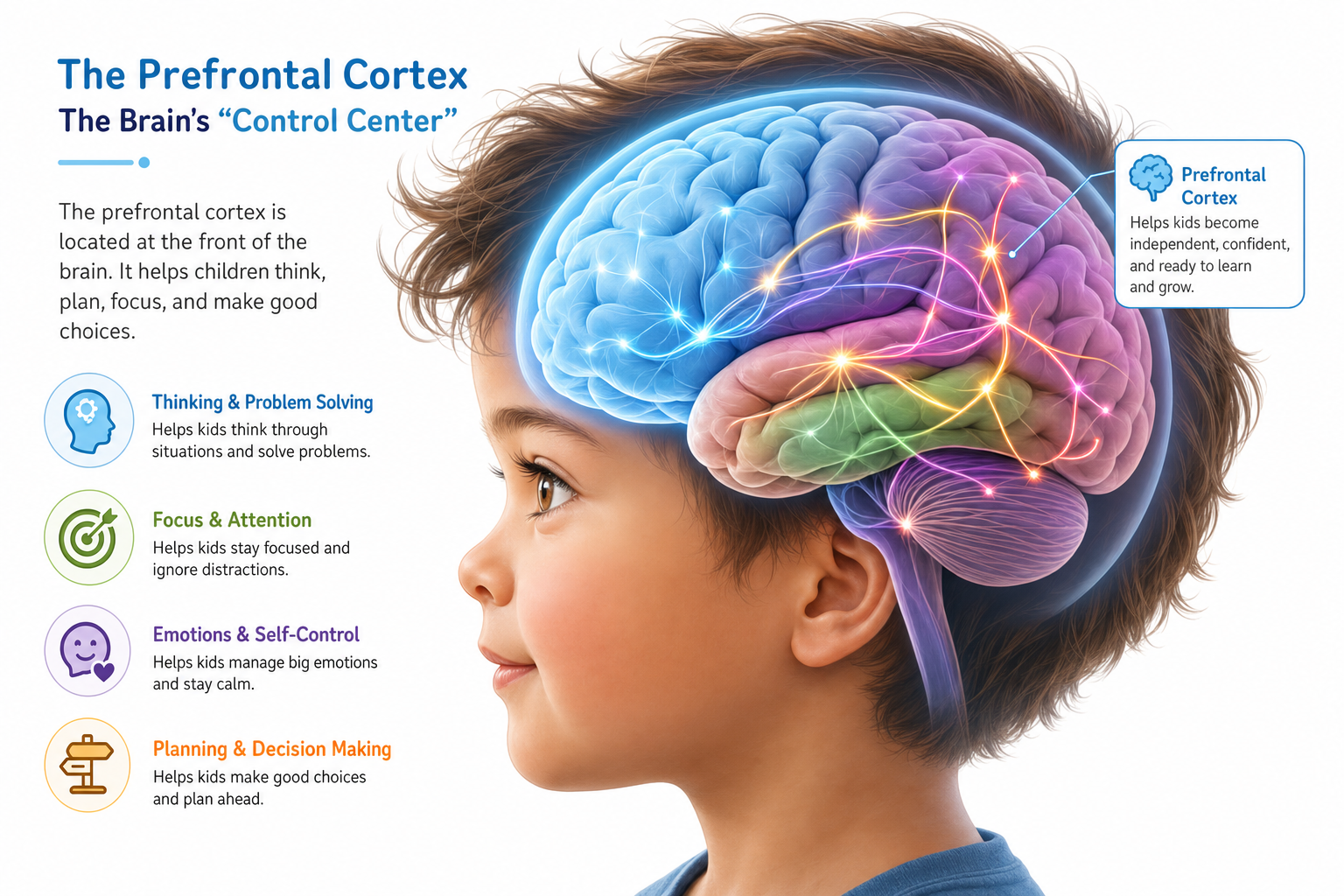
It is easy to assume that when a child ignores a direct command, they are being intentionally defiant or "spoiled." However, developmental psychology paints a very different picture. The ability to follow instructions, resist distractions, and complete a task relies on a set of mental skills called executive function. These skills are controlled by the prefrontal cortex — the area at the very front of the brain.[1]
Here is the catch: between the ages of three and five, the prefrontal cortex is undergoing massive, rapid development. It is essentially under construction. While your child is physically capable of putting on their shoes, their brain is not yet fully equipped to pause their current impulse (playing with a toy), plan a sequence of actions (find shoes, sit down, put them on), and execute that plan without getting distracted by a shiny object halfway through.[2]
When your child fails to follow your directions, it is often a sign that their brain is doing exactly what a four-year-old's brain is supposed to do: exploring, feeling, and living entirely in the present moment. They are not giving you a hard time; they are having a hard time managing their own impulses.
The Psychology of "You're Almost 5!"
So, your child is distracted, and you pull out the age card. "You're almost 5! You should know better."
This phrase falls into a category of discipline that psychologists refer to as shaming. While it may not feel as severe as traditional punishments, it operates on the same emotional mechanism. You are highlighting a gap between who the child is right now (distracted, messy, uncooperative) and who they should be (mature, capable, compliant).
Guilt vs. Shame: A Crucial Distinction
To understand why this phrase backfires, we have to look at the difference between guilt and shame in early childhood development.
Guilt is a feeling tied to a specific action: I did a bad thing. When a child feels guilt, it often motivates them to repair the situation. They might apologise, try to fix what they broke, or change their behavior.[3]
Shame, on the other hand, is tied to the self: I am a bad person. Or, in this context: I am not good enough for my age. Shame makes a child feel fundamentally flawed. Instead of motivating positive change, shame typically causes children to withdraw, hide, or act out defensively.[4]
When we tell a child they should "act their age," we are not giving them actionable feedback on their behavior. We are labelling their current state of being as inadequate.
The Danger of Labels
Labelling theory in psychology highlights how the words we use to describe children can become self-fulfilling prophecies. When children are given labels — even implied ones like "immature for your age" — it affects how they view themselves.[5]
If a child consistently hears that they are not acting like a "big kid," they may internalise the idea that they are inherently difficult or incapable. This erodes their self-esteem and can actually increase the exact behaviors you are trying to stop. When children feel bad about themselves, they rarely behave better.
What Actually Works: Practical Hacks for Parents
If reminding them of their impending birthday does not work, what does? Here are some practical, research-backed alternatives to get your child moving without resorting to age-shaming.
1. Tell Them What To Do, Not Who To Be
Instead of focusing on their age or character, focus entirely on the specific action required. Research shows that children respond much better to clear, direct instructions about what you want them to do.[6]
Keep the command simple and direct. Do not add a lecture. Once they comply, immediately offer specific praise: "Thank you for putting your shoe on so quickly."
2. The "If/Then" Strategy
When a child is refusing to complete a task because they are messing around, you can use "if/then" statements to provide them with a sense of control while clearly outlining the natural consequences.
This shifts the motivation from avoiding shame to earning a positive outcome. It also helps their developing prefrontal cortex understand cause and effect.
3. Break It Down (The "Chunking" Hack)
Remember that under-construction prefrontal cortex? It gets easily overwhelmed by multi-step instructions. "Get ready for school" involves finding clothes, getting dressed, finding shoes, putting them on, packing a bag, and getting to the door. For a four-year-old, that is a mountain of executive function tasks.
Break the larger goal into single, manageable chunks. Celebrate the completion of each chunk before moving to the next.
4. Use "When/Then" for Non-Negotiable Tasks
Sometimes, a child just does not want to do the thing. In these moments, "when/then" is a powerful tool for compliance.
Notice the subtle difference from "if/then." "When/then" implies that the task is non-negotiable. It is going to happen; the only question is how quickly they want to get to the fun part.
5. Connect Before You Direct
Often, when a child is ignoring instructions and messing around, they are actually seeking connection. They have realised that not putting their shoes on guarantees your full, undivided (albeit frustrated) attention.
Take 30 seconds to connect with them before giving the instruction. Get down to their eye level, make physical contact, and enter their world briefly.
The Bottom Line
Parenting a four-year-old is a daily exercise in patience. It is completely normal to feel frustrated when your child seems to forget every basic skill they have learned over the past four years.
However, the phrase "You're almost 5!" is a trap. It asks a child to rely on executive function skills they do not fully possess yet, while simultaneously inducing shame that makes them less likely to cooperate.
Your child is not giving you a hard time; they are having a hard time. By ditching the age-shaming and focusing on clear directions, manageable chunks, and positive reinforcement, you can save your sanity and help build the exact brain pathways they need to eventually become that responsible five-year-old.
References
[1] Moriguchi, Y., & Hiraki, K. (2013). Prefrontal cortex and executive function in young children: a review of NIRS studies. Frontiers in Human Neuroscience, 7, 867. pmc.ncbi.nlm.nih.gov/articles/PMC3865781/
[2] Diamond, A. (2002). Normal development of prefrontal cortex from birth to young adulthood. Principles of Frontal Lobe Function.
[3] Tangney, J. P. (1998). How does guilt differ from shame? In Guilt and Children. Academic Press.
[4] Budiarto, Y., & Helmi, A. F. (2021). Shame and self-esteem: A meta-analysis. Europe's Journal of Psychology, 17(2), 131–145. pmc.ncbi.nlm.nih.gov/articles/PMC8768475/
We've all said it. But does telling your child they're 'almost 5' actually work? We look at the psychology behind age-based expectations — and the hacks that actually get results.
Our brand-new Minisport Hub is officially open, offering summer camps, weekend drop-ins, and Term 1 classes in a fun, safe, and modern environment. We’re also excited to share we have introduced cricket to term 1, refreshed our coaches’ first aid skills, and enjoyed a team day out. Plus, we’re expanding globally — Minisport Taiwan is launching soon!
While caffeine is a common part of many adults’ daily routines, even small amounts can pose serious health risks for young children. This guide explains why children are especially vulnerable to caffeine’s effects, outlines safe intake limits by age group, and helps parents make informed choices to protect their child’s health.
Matt, founder of Minisport HK, shares the honest truth about co-sleeping with his 4.5-year-old — and the unconventional solution that actually works: both parents leaving the house by 7:30pm every single night.