Remember when parenting meant telling kids what to do—and expecting them to do it, or else? That’s how many of us were raised. Clear rules, quick compliance, and consequences if you didn’t listen. My own parents, visiting recently, summed it up: “This negotiating with your toddler thing is driving your sister up the wall. We just can’t relate.
”But times have changed. Now, experts urge us to negotiate, validate feelings, and avoid the old “because I said so.” The result? Modern parents face a whole new set of challenges. How do you get your child to listen without constant battles? Is negotiation helping—or just making things harder? And should you even do it?
And let’s be honest: the advice is overwhelming. For every method, there’s a school of thought that says you’re doing it wrong. Too strict? You’re crushing their spirit. Too flexible? You’re raising a tyrant. No matter what you try, it’s easy to feel like you’re getting it wrong. So what actually works when negotiating with toddlers—and should you even do it? Here’s a balanced look at what the research—and real-world experience—has to say. Schools of Thought Against Negotiation
Some approaches say no negotiation at all:
Authoritarian Parenting: Strict rules, children obey without question. Can reduce autonomy and increase anxiety (Baumrind, 1966).
Strict Behaviorism: Reinforcement and punishment, no negotiation. Focus on compliance (Skinner, 1953).
Traditional Norms: Emphasize respect and hierarchy; negotiation is seen as undermining authority.
These warn that negotiation confuses kids and weakens authority. But many experts suggest mixing firm limits with respectful communication.
The “Because I Said So” Approach
Gets quick compliance but may hurt autonomy and trust (Kuczynski & Kochanska, 1990; Baumrind, 1966). Use sparingly, mostly for safety. Pair firm limits with calm explanations (Grolnick & Pomerantz, 2009).
🔍 Quick take: Sometimes you must lay down the law—but explaining why softens resistance.
Making Negotiation Work: Research-Backed Strategies
1. Offer Limited Choices: Two options, not open-ended.
2. Set Clear Boundaries: Define non-negotiables calmly.
Example: “Hold my left or right hand crossing the street.”
Why: Creates security, reduces power struggles (Skinner, 1953).
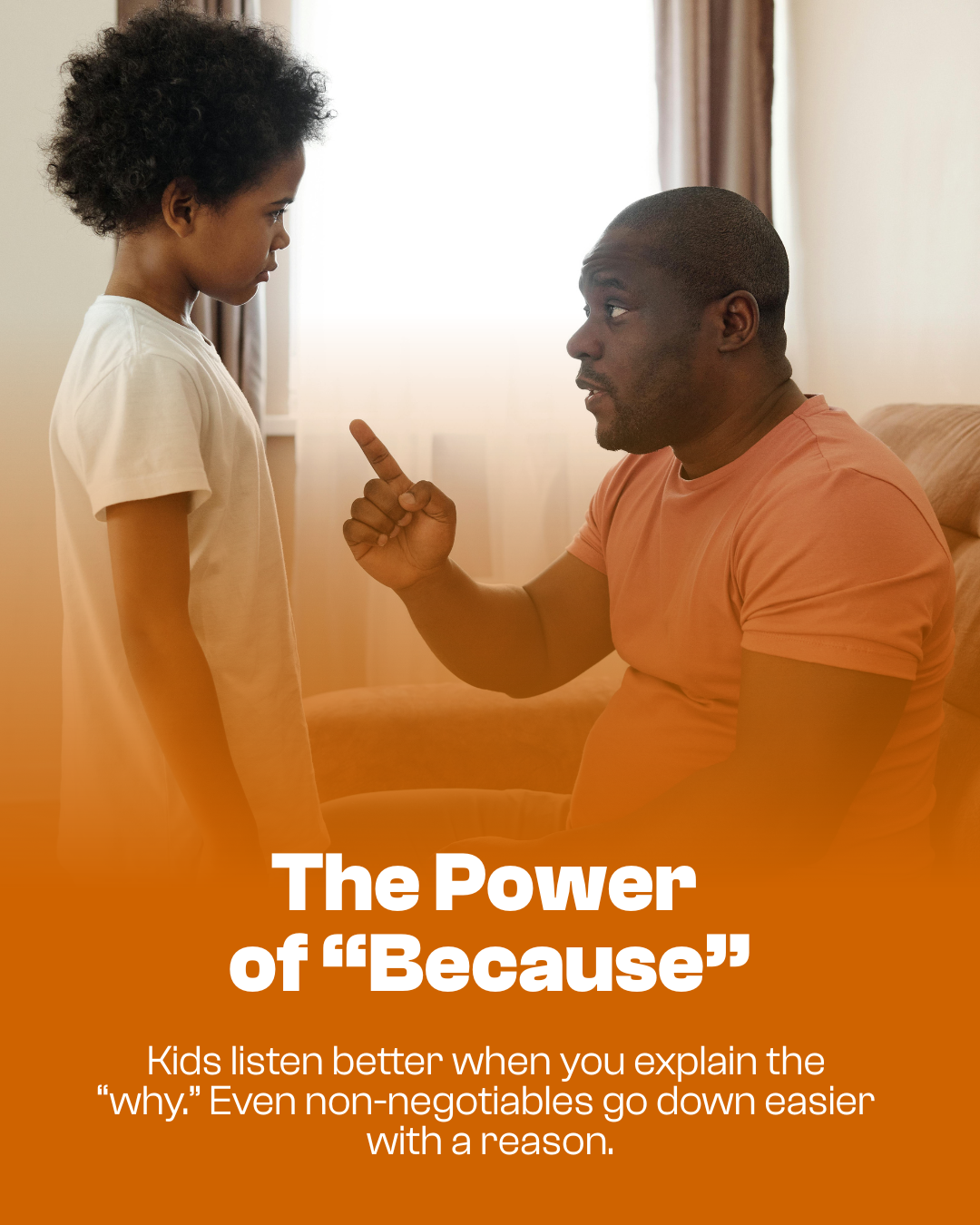
3. Explain the Why: Brief reasons help kids cooperate.
Example: “We tidy so no one trips.”
Why: Builds understanding, softens resistance (Baumrind, 1966; Grolnick & Pomerantz, 2009). Adults dislike being told what to do without reasons—kids do too.
Getting dressed in the morning (“Do you want to wear the red shirt or the blue one?”)
Choosing snacks (“Would you like apple slices or banana?”)- Picking a bedtime story (“Which book should we read tonight?”)
Deciding the order of routines (“Brush teeth first or put on pyjamas first?”)- Leaving the playground (“Do you want to walk or skip to the car?”)
Transitioning between activities (“Do you want five more minutes or help packing up now?”)- Selecting a toy for bath time (“Which toy wants to swim today?”)
Deciding who goes first in a game (“Should you or your brother go first?”)
When to Avoid Negotiation
Some moments require clear, non-negotiable instructions for safety, health, or essential routines. But even when you’re not negotiating, explaining the “why” helps your child understand and accept your decision:
Crossing the street: “We hold hands for safety—cars move fast here and I need to keep you safe.”
Bedtime: “It’s time for bed now because your body needs rest to grow strong and have energy for school and play tomorrow.”
Taking medicine: “You need to take your medicine so your body can fight germs and you can feel better.”
Leaving in an emergency: “We have to go now because it’s not safe to stay here.”
Stopping unsafe behaviour: “No hitting or biting—everyone deserves to feel safe and happy.”
Getting in the car seat: “You have to buckle up to stay safe in the car—just like everyone else.”
Washing hands after using the toilet: “We wash hands to keep germs away and stay healthy.”
Attending school or daycare: “It’s school time now—you’ll see your friends, learn new things, and I’ll be back to pick you up later.”
Explaining the reason behind your instruction—even when there’s no room for negotiation—builds trust and helps your child make sense of routines and boundaries. It shows respect, reduces resistance, and helps kids internalise healthy habits.
Should You Meet Your Child Halfway?
Meeting halfway—compromising or letting your child have input—only applies to certain situations where flexibility is safe and reasonable. It’s not for every moment.
📌When it works:
Deciding which park to visit on the weekend (“Would you like to go to the playground or the beach?”)
Choosing a snack after school (“Do you want crackers or fruit today?”)
Picking a song for the car ride (“Which song should we play first?”)
📌When it doesn’t:
Setting screen time limits (“Screen time is over for today, we’ll choose again tomorrow.”)
Attending a family event (“We’re going to Grandma’s house now, let’s think of a fun game for the journey.”)
Be open to your child’s input when it’s appropriate—sometimes they suggest better ways! This challenges “my way or the highway” thinking and builds confidence and emotional intelligence (Kuczynski & De Mol, 2015).
Understanding Non-Negotiables
Some boundaries just aren’t up for discussion—these are your non-negotiables. Safety, health, and core routines (like bedtime or car seats) fall into this category. Research on consistent parenting (Baumrind, 1966; Grolnick & Pomerantz, 2009) shows that children feel more secure and behave better when they know certain rules are firm. Non-negotiables give kids structure, reduce anxiety, and help them learn important limits—even if they push back in the moment.
Skip Negotiation Altogether
Negotiation isn’t always the best or only way to get cooperation from toddlers. In fact, trying to negotiate every little thing can lead to frustration and power struggles for both parents and kids. Sometimes, the smartest move is to avoid negotiation entirely by using playful, imaginative, and engaging strategies that naturally encourage your child to cooperate without feeling pressured. These creative approaches turn daily tasks into fun moments, making routines smoother and more enjoyable for everyone.
🎲Try:
Turning routines into games
Asking playful questions
Framing tasks as challenges
Adding imagination
Using favourite toys to help clean up
Playing music to energize tasks
Kids love fun. Creative approaches get things done—no struggle, just smiles.
Your energy matters. Kids sense emotions deeply (Siegel, 1999). Even clear instructions can be misread if you’re stressed or rushed. Rushing fuels conflict. Kids experience time differently (Friedman & Laycock, 1989). Buffer zones reduce tantrums (Lewin, 2015). Plan with flexibility. Calm parents, calm kids.
💡What to Watch For
📌Negotiation working:
Positive responses.
Fewer tantrums.
More cooperation.
📌 Negotiation overused:
Frequent delays.
Parent exhaustion.
Blurred boundaries.
Conclusion
Parenting toddlers is no small feat—especially when it feels like every day is a negotiation marathon. But remember, negotiation isn’t the only tool in your kit, nor is it always the right one. Sometimes standing firm with clear boundaries is what keeps everyone safe and sane. Other times, offering simple choices or meeting your child halfway can build their confidence and cooperation. And when all else feels like a power struggle, skipping negotiation altogether with playful distractions, imagination, and a calm mindset can turn chaos into cooperation.
The biggest secret? Your energy matters more than you think. Kids are little emotional sponges, and how you show up—calm, patient, and flexible—can make all the difference between a battle and a breakthrough.
So take a deep breath, pick your battles wisely, and trust that with a mix of firmness, empathy, and creativity, you’re helping your child grow into a confident, resilient little human. You’ve got this—and every small win counts.
Feeling overwhelmed by all the parenting advice out there? Negotiating with toddlers can feel like a daily battle, but it doesn’t have to be. This guide breaks down when to stand firm, when to give choices, and how your mood and approach can make all the difference. Discover practical tips and playful strategies...
Our brand-new Minisport Hub is officially open, offering summer camps, weekend drop-ins, and Term 1 classes in a fun, safe, and modern environment. We’re also excited to share we have introduced cricket to term 1, refreshed our coaches’ first aid skills, and enjoyed a team day out. Plus, we’re expanding globally — Minisport Taiwan is launching soon!
While caffeine is a common part of many adults’ daily routines, even small amounts can pose serious health risks for young children. This guide explains why children are especially vulnerable to caffeine’s effects, outlines safe intake limits by age group, and helps parents make informed choices to protect their child’s health.
The most common elbow injury in toddlers comes from the most innocent moment — swinging them by the hands. Here's the science, the signs, and the simple swap every parent needs to know.
Flying with a toddler is often a recipe for stress — but it doesn’t have to be. From navigating HKIA’s busy terminals to keeping your little one entertained at 30,000 feet, this guide shares surprising hacks to make your next flight smoother and preserve your sanity.
In this post, we break down our new graduation system, our three development pillars, why the programme now ends at age five, and what’s changing in Term 1 — from themed games and app resources to new coaches, new equipment, and free beach events for Term 1 enrolled families.